Math Reasoning That Avoids Algorithm Traps
by MiddleWeb · 07/30/2025
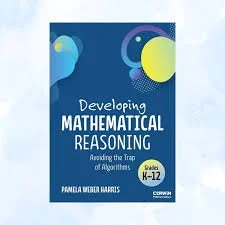
Developing Mathematical Reasoning: Avoiding the Trap of Algorithms (Grades K-12)
By Pamela Weber Harris
(Corwin, March 2025 – Learn more)
Reviewed by Kathleen Palmieri, NBCT
During the last trimester of school, I made plans to focus part of my summer professional reading on math techniques and strategies. As an educational researcher and classroom teacher, I have spent a lot of time digging into what makes my math students “tick.”
Forging ahead with my plan, I came across the Corwin title Developing Mathematical Reasoning:Avoiding the Trap of Algorithms by Pamela Weber Harris. Two things struck me in this title: “Mathematical Reasoning” and “The Trap of Algorithms.”
As with many books, I first thumbed through to see what jumped out at me. What caught my attention was the “Domains of Reasoning” and the many illustrations. With my interest already piqued, I then came across “Frequently Asked Questions,” QR codes leading to videos demonstrating the various domains of reasoning, and “Try it in your Classroom.” Forget waiting for summer, I dove into the book, reading it in two days and finding ways to try out the examples offered with my class.
The full spectrum of Mathematical Reasoning with Longitudinal Domains helped me to reflect on what I had observed with many of my students. “The domains are arranged left to right because it is critical to understand that one domain is not inferior to another, merely less sophisticated…each domain contains its own hierarchy of less to more sophisticated forms of that reasoning.” (p. 46) From left to right, the domains are Counting Strategies, Additive Reasoning, Multiplicative Reasoning, Proportional Reasoning, and Fractional Reasoning.
The Longitudinal Domains stretched to include Spatial Reasoning throughout all five domains, Algebraic Reasoning beginning from Additive Reasoning, including Fractional Reasoning, and Statistical Reasoning encompassing Multiplicative Reasoning and Fractional Reasoning. I liked how the word “sophisticated” was used to emphasize the growing mathematical process of reasoning.
As a teacher of intermediate (5th grade) students, I was very curious about “Multiplicative Reasoning” and “The Trap of Multiplication and Division Algorithms” found in chapter four. (p.95) Place value is the first topic in my school’s math curriculum and seems to be the sticking point for some students as the concepts get more complex. Reasoning about multiplication and division depends upon an understanding of place value and helps to avoid the “Trap of Algorithms” through the use of “Problem Strings” and ratios.
The example provided in the book started with 2400 ÷ 24. A student responds with the correct answer of 100, “with the reasoning that when multiplying by 100, the answer will be the original number ‘bumped up by two place values.’” Next, the teacher draws a ratio table on the board, not the standard division “house,” to “emphasize the scaling of 1 to 100 and 24 to 2400 as ‘x 100.’” Throughout this “Problem String” the teacher works from the “helper problem of 2400÷24” to move to the next problem of 1200÷24, 1800÷24, 1848÷24, etc. (pp. 96-102)
What ensues is an engaging math reasoning activity with students actively dividing using their reasoning, what they notice about the numbers, and what they know as math students. Trying this Problem String with my class proved to be both engaging and worthwhile, leaving students eager for more.
My classroom experience aligns closely with Weber Harris’s explanation: “As students realize they can group the groups, they chunk the problem into manageable parts” (p. 106). This approach fosters mathematical confidence, as students’ reasoning begins to resemble rich mathematical discourse rather than reliance on a single algorithm.
There are so many fine examples of ways to impart reasoning without algorithms in this book. “The Trap of a Traditional Division Algorithm” demonstrates the steps of the division algorithm and compares it to finding an equivalent ratio that’s easier to solve. Weber Harris also provides the three main traps of the division algorithm (p. 131), the third being “division becomes steps to memorize.” The “Try it in Your Classroom” suggested activities, especially “Doubling and Halving” (p.139), are highly engaging. Teacher tips throughout the book are easy to implement, and “Frequently Asked Questions” are thought-provoking.
Finally, “Developing High Leverage Teacher Moves” offers ideas such as students using private response signals and teachers using a neutral response. Weber Harris asks us to celebrate reasoning writing, “Everything in your classroom, from how you handle homework to grading tests to seating arrangements, should reflect that you value reasoning first and not merely answer-getting.” (pp.239-242)
Developing Mathematical Reasoning: Avoiding the Trap of Algorithms (Grades K-12) has been an enlightening mathematical experience for me as a math teacher. As Weber Harris states, “I’m telling you the goal of mathematics education is to develop mathematical reasoning. This is not just a fluffy ‘think better’ idea; it includes content. Learning the content is important. In fact, reasoning mathematically means owning content, deep down, inside and out, with a web of interconnected relationships.” (p. 223).
07/04/2024 / Review
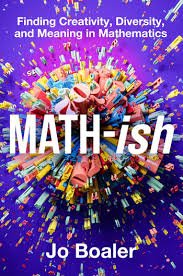
Mathish
by Jo Boaler
When I learned that Dr. Jo Boaler had a new book ready to be released, I knew I had to have it. I have read many of her papers and books, including Limitless Mind: Learn, Lead and Live Without Barriers (2019), and Mathematical Mindsets: Unleashing Students’ Potential Through Creative Mathematics, Inspiring Messages, and Innovative Teaching (2016).
Dr. Boaler is the Nomellini & Olivier Professor of Education at Stanford University, specializing in mathematics learning. She co-founded youcubed.org which provides educators, students, and parents with resources to engage, excite, and inspire students about mathematics. Dr. Boaler is currently co-leading a K-12 Data Science Initiative and was named as one of the eight educators “changing the face of education” by the BBC.
What I have found inspiring in all of her work is the constant thread of growth mindset. When I received a copy of MATH-ish to review for MiddleWeb, I immediately began reading it and found myself immersed in the beauty and the diversity of math.Math-ish?
First, let me start by saying this is not your typical professional text on math. Boaler uses real life experiences and weaves mathematical teachings into the stories she shares. The writing flows and the words help to provide visuals in the reader’s mind. It is conversational in tone, and when a new term such as “-ish” was introduced and defined I found myself easily grasping its meaning.
“I will use the term mathish,” Boaler writes, “to describe a way of thinking about the mathematics we use in the real world that could be a powerful tool for student thinking. Embracing these concepts of mathematical diversity and of math-ish are keys to stepping into a rich understanding of mathematics that is equitably meaningful for all learners, regardless of education, gender identity, race, or ethnicity, and beyond.” (pg. 6)
Beyond Narrow Mathematics
Boaler’s discussion of “Narrow Mathematics,” the idea that there is only one way to solve and one answer, rings true because most math curricula teach a strategy, expect one answer, and as Boaler explains, “They are always numerical, and they do not involve visuals, objects, movements, or creativity.” (pg. 9).
Boaler explains that this narrow approach turns students away from STEM courses and many times prevents students who need to pass a mathematics course from achieving their goals. “Narrow mathematics ends the hopes and dreams of millions of college students. Not only is this a problem for the students, but it also causes severe problems for US society, threatening the future of the economy, the development of science, technology, medicine, and the arts.” (pg. 11)
She argues that we need to move away from this narrow math and think about mathematical diversity, looking through many lenses to make it more visual. We need to offer ways for students to collaborate and share what they are thinking, picturing, and possibly solving a particular problem.
Metacognition and Math: Throughout the text, Boaler offers research and ideas from education, cognitive science, neuroscience, and psychology.
In Chapter Two, “Learning to Learn,” she discusses the value in metacognition and its impact on students’ achievement. Metacognition is encouraged through eight mathematical strategies that are fully explained in the book. Below is a brief introduction to each. (pages 39-45)
Take a Step Back: Consider what the problem is asking you.
Draw the Problem: this helps to create activity in the visual parts of the brain and stimulate important connectivity between numerical and visual areas.
Find a New Approach: asking students to think of other ways to solve the problem.
Reflect on Why: having students explain their thinking on a mathematical process.
Simplify: creating a simpler problem.
Conjecture: asking students to come up with an idea that has not been proven; it is “still at the idea stage.”
Become a Skeptic: pairs with students’ work providing conjectures; inviting students to reason and “to take on the role of skeptic.”
Try a Smaller Case: Boaler considers this strategy a super power. I highly suggest you read on in the book to learn more about this.
Journaling, in which students reflect on their mathematical thinking, is also highly valued. Reflecting on your own learning is an important part of being metacognitive.
The Power of Struggle
Boaler suggests having a “struggle” conversation with students, and I do this with my own class. I believe it’s important for students to know it’s “okay to not know,” but they need to allow themselves to think. There are so many times In my classroom when this has led to students having “aha” moments, which build their math confidence.
I also agree about creating what Boaler calls a “mistake-friendly environment” for learners. “Learning is a process, not an outcome, and the times of struggle are when the most dynamic opportunities occur.” (p. 90)
Bringing Math to Class
The early chapters of MATH-ish provide pathways into what is learned throughout the book. Chapter Four, “Mathematics in the World,” cuts to what I believe is a very important discussion around changing our current curriculum in K-12 and what’s needed in college as well as life.
Looking more deeply into the term “math-ish,” Boaler shows how it relates to our everyday use of numbers and how those uses differ from how we use numbers in school. “When we use numbers in our lives and workplaces, they are nearly always imprecise estimates, what I calls ish numbers,” she writes. “Ish numbers turn out to be numbers we most need in our lives…they could transform people’s approach to mathematics if they were present in their learning journeys.”
Some examples of questions that are generally answered with ish numbers include “How old are you?” and “How much paint do I buy to paint the wall?” (p. 108). There are also “ish” shapes such as kites and sugar cubes to name a few.
Boaler proposes, “Before anybody works on a calculation or any other mathematics problem, they think about what the answer will be – they come up with an ish answer.” (p. 111) Ish numbers can be related to estimates, but it is only when a student has number sense that they can work out an ish number. Boaler states that many students, when asked to estimate, will actually figure out the exact answer and then round for an estimate.
With number sense, a student may use a guess-and-check strategy to solve a problem. I’ve seen this in my own classroom where some students can easily find the “ish” number because they’ve learned number sense and ways of manipulating numbers in different ways. (Boaler demonstrated this idea of number sense in a famous 3-minute video.)
“When we bring ish into our lives,” Boaler writes, “we are more protected from the dangers of perfectionism – a damaging mindset – and from binary thinking.” (p. 113)
Starting with Visual Concepts
The concept of “Mathematics as a Visual Experience,” Chapter 5, is critically important in teaching mathematics. For learning fractions, most curricula employ narrow mathematics with a set of rules, providing a “must-do” way to solve in the four operations. However, Boaler explains, “All of these rules trample over the most important part of fraction understanding: the fact that the two numbers – the numerator and the denominator – are in a relationship…it matters how big they are in relation to each other.” (p. 163).
My students became more engaged when I made the switch to the visual teaching of fractions. Allowing students to use a constructive approach to solving with fractions is powerful. There is a place for rules and steps in math. As Boaler clarifies, “I am not arguing that algorithms are not useful; I am arguing that they should not be taught to students until they understand fractions conceptually. Students need to understand what a fraction is and be given a lot of experience thinking about the value of fractions as a conceptual whole.” (p. 164)
Chapter 6, The Beauty of Mathematical Concepts and Connections, notes that “teaching and learning in ways that allow people to develop conceptual and connected understandings – is a key part of mathematical diversity.” Boaler goes on to share that “one of my favorite methods in developing conceptual insights into big ideas is journaling or making sketchnotes. Jotting words or visuals is a really good exercise for listening to ideas, connecting them, and keeping track of them.” (p. 210)
Diversity in Practice and Feedback, Chapter 7, shares teaching examples from Phoenix Park in the UK, middle school classes in California, and college classes. I found her concept of a feedback loop interesting as it “…is not focused on personal performance: that is, it does not communicate whether a person is right or wrong. Instead it is focused on the work that is being learned or presented – and whether the idea needs revision.” (p. 237)
Bringing the Elements Together
A New Mathematical Future, Chapter 8, concludes the book, offering a reflection of what has been discussed, from “sharing the importance of students learning how to learn with empowering mathematics strategies and the importance of being comfortable with times of struggle…(to) students learning both precise and “ish” numbers, shapes, and encountering multiple opportunities to develop representational models.” (p.241)
Allowing students to struggle with math, be collaborative, and have math conversations, letting their ideas and thought process help them with problem solving before introducing methods or strategies, is powerful and extremely important. Making math visual and including the opportunity to learn data literacy in the younger grades will help to ignite engagement in math. The idea that mistakes help us learn is key to students gaining math confidence.
Dr. Boaler shares “Five Principles for Becoming An Effective Change Agent” in mathematics education as the book nears its end.
Believe in Yourself
Practice Empathy
Build a Network
Investigate
Develop a Warrior Mindset
Being an avid reader of Dr. Boaler’s writing, I see her belief system deeply embedded in each of these principles.
“When I eventually started to talk about the attacks on my work,” she writes, “I was contacted by hundreds of women scientists who shared similar experiences of harassment and defamation. That support from people in similar situations changed everything for me.” (p. 264) She developed her warrior mindset.
Essential Reading!
I highly recommend MATH-ish to every educator. As a committed math teacher who has seen these concepts have a huge impact in my own classroom, I have great respect for Dr. Boaler and the work she continues to do to make change in the way students learn math.
To all those who have rejected Boaler’s work, I ask that you see the beauty in allowing students to use their ideas, their problem-solving abilities, and their ability to learn math from visuals, models, data tables, and collaboration. Allow the world of math to be enlightened by the research and data collection of Boaler and her colleagues.
Any day of the school week, you can come into my math class to witness the collaboration, math discussions, drawings, models, and sheer excitement of students who once hated math, now building their math confidence and skill because of what I’ve learned, and continue to learn, from Dr. Jo Boaler.
Pair Depth of Knowledge with Cognitive Rigor
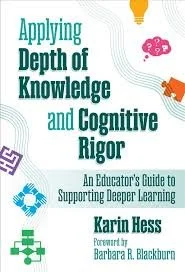
Applying Depth of Knowledge and Cognitive Rigor: An Educator’s Guide to Supporting Deeper Learning
By Karin Hess
(Teachers College Press, 2025 – Learn more)
Reviewed by Katheen Palmieri
In today’s classrooms, educators are continually challenged to move beyond surface-level instruction and create opportunities for students to think critically, problem-solve, and apply their learning in meaningful ways.
Terms like rigor, higher-order thinking, and depth of knowledge often surface in conversations about student achievement, but applying them effectively can feel complex.
Dr. Karin Hess’s Applying Depth of Knowledge and Cognitive Rigor: An Educator’s Guide to Supporting Deeper Learning provides clarity and practical tools for teachers seeking to design learning experiences that truly deepen understanding.
Back to the basics
In this book Hess “returns to the basics of what DOK is, what it is not, and how to apply a cognitive rigor mindset with fidelity so that every student’s learning goal is to achieve deep understanding” (Introduction). The text is organized into modules that focus on the “Six Big Ideas When Applying DOK and Cognitive Rigor” (Table 0.1, p. 2).
Rather than being a text to read straight through, it is designed for educators to reference according to specific needs, making it a practical professional resource. Appendix D of this book offers an “Observation Note Catcher” that I found helpful to use as I came across video resources in the book.
Connecting Bloom and Webb
One of the most valuable aspects of Hess’s work is her ability to connect and clarify key frameworks that shape educational practice. She explores Bloom’s Taxonomy and Webb’s Depth of Knowledge framework, and references other thinking models like Edward de Bono’s Six Thinking Hats (1999), a business strategy repurposed here for classroom use. While Hess often returns to Bloom’s Taxonomy for its accessibility and familiarity, she pushes readers to consider how Bloom’s and Webb’s frameworks intersect – a consideration that led to her development of the widely used Hess Cognitive Rigor Matrices.
The book is rich with resources, particularly the tables provided throughout. These serve as both quick reference guides and deeper research tools. For example:
• Table 1.1 (p. 9) compares Bloom’s Taxonomy with Bloom’s Cognitive Process Dimensions.
• Table 1.2 (p. 10) clarifies Webb’s Depth of Knowledge across four content areas with test item alignment descriptions.
• Tables 1.3–1.4 (pp. 11–14) demonstrate how to analyze intended DOK levels and use Cognitive Rigor Matrices to show increasing complexity.
• Table 1.5 (p. 15) illustrates a progression of learning and assessment tasks across DOK levels, including purposes, student engagement, “I can” success criteria, and content-specific examples.
Activating readers in learning
Beyond tables and frameworks, Hess structures the book so that readers are active participants in the learning process. Throughout the modules, she includes activities that encourage readers to pause, reflect, and jot down examples, descriptions, or insights. Additionally, she integrates videos that expand on the text. For example, in her master class video Are Your Students Thinking Deeply, or Just Working Harder, part 3, Hess explains how to use scaffolding strategies to deepen thinking. (p. 20)
In Module 6, “Applying a Cognitive Rigor Mindset to Assessing Deeper Learning,” Hess challenges educators to define what makes an assessment “high quality” by considering both skills and concepts. It provides clear criteria to evaluate validity and includes tools for summative and performance-based assessment practices (p. 76). A complementary video – Part 4 of Hess’s master class – further explores balance in summative assessments and demonstrates how to use simple grading scales for open-ended discussions (p. 79).
Finally, the appendices offer a wealth of practical tools, including the Hess Cognitive Rigor Matrices and DOK planning tools (downloadable resources), as well as the “Observation Note Catcher” mentioned previously. These materials strengthen the book’s role as both a guide and a working reference for educators.
In today’s data-driven educational environment, educators need to reflect not just on what we teach, but on how we design, support, and assess learning. Hess’s book provides the tools, structures, and reflective prompts needed to engage with Depth of Knowledge and cognitive rigor meaningfully. It is a resource for review, reflection, and refinement of practice supporting teachers in their ongoing work to design learning experiences that move students toward deeper understanding.
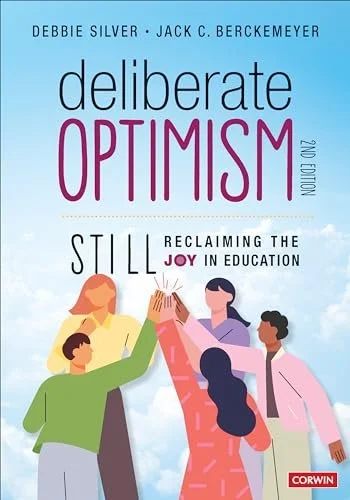
Deliberate Optimism
2nd Edition
Debbie Silver and Jack C. Berckemeyer
In 2015 Debbie Silver, Jack Berckemeyer, and Judith Baenen published Deliberate Optimism: Reclaiming the Joy in Education. At the time educators were feeling defeated and distressed as their roles were seemingly devalued in public perception. Standardized testing, scripted curriculums, and the push to decrease teacher creativity for increased test scores, and the ever-stressful teacher evaluation system added to the already stressed environment. Who would have thought it could get any worse, then in 2020 the pandemic did just that, causing many educators to leave the profession.
Despite all that we in education have endured, Debbie Silver and Jack Berckemeyer maintain, “Teaching remains the most noble profession. What other group of people has more ability to shape the future by empowering the next generation to think, to create, and to act compassionately toward their fellow humans?” (xii) Thus the second edition of Deliberate Optimism is updated offering revised principles of optimism, updated strategies and scenarios, interactive action step exercises and QR codes leading to self assessments and videos to name just a few of the highlights.
The Four Principles for Deliberate Optimism for Educators include:
Gather information
Control what you can.
Do something positive.
Own your part.
This second edition includes a chapter for each principle, each authentically presented. Starting with “Gather Information,” which sounds so simple, yet is the catalyst for solving many false truths that can lead to stressful misunderstandings. Because we lead such busy, overscheduled lives, it is easy to listen to others' viewpoints on critical issues from discussions at workshops or board meetings without thinking about the facts. This sharing leads to negative thoughts and feelings and creates a “us versus them” environment. Throughout this principle, words such as “us”, “they”, and “those people” are bolded to emphasize the negative talk that can only lead to a more stressful, negative climate. Taking the time to fact-check helps to alleviate such strain. Action Step 1.1 “Fact Check” and the “Guiding Questions on Realistic Awareness” help the reader to take a close, personal look at this principle.
Principle two, “Control what you can,” offers the idea that if we are constantly worrying over things we can’t change, we are not only wasting our time, but we are causing ourselves undue stress. On page 35, the authors provide a table with examples of “What you can’t control” and “What you can control,” offering realistic scenarios such as parent expectations you can’t control, but can control the way you communicate. Action Step 2.3 QR code “Positive Reframing"(page 39) is a helpful 5-minute video that asks you to consider something that is currently troubling you and how you may be able to reframe the issue in a more “positive light”.
The third principle, “Do something positive”, asks us to make positive efforts to “just keep moving forward”. (page 56) The authors offer suggestions such as keeping ourselves upbeat even when those around us are negative, not overloading our plates, and most importantly, taking care of our physical and mental health. In “Taking positive steps with our health” the authors write, “In a career that often requires us to be selfless, many teachers see themselves as healers and fixers. We get so busy taking care of everyone else that we often neglect our own welfare. Too many times, we put our own needs last and tend to think of those who put effort into taking care of their physical, psychological, spiritual, mental, and social needs as being a bit self-absorbed and even selfish. Nothing could be further from the truth. Burning the candle at both ends will eventually lead to complete and total burnout, and we have too many excellent teachers leaving the field already. Taking care of oneself is probably the least selfish thing a teacher can do.” (page 60)
The fourth principle, “Own your part” looks at our responsibility over how we respond to the many issues we have no control over. However, it is equally important to reexamine when programs and tasks within our control aren’t working. We need to take responsibility for what goes on in our classroom and do what is best for our students. The authors offer “Tips for Choosing Responsibility” outlining the need to prioritize ourselves, stop blaming, take time for self reflection, assume accountability, avoid excuses, stand up to detractors, and the one that stood out to me “We stop being our own worst enemies”. “We refrain from having detrimental conversations about our classrooms, our schools, our districts, and other educators in public. We must maintain a realistic optimism about our profession…We need to stand together, support one another, and make every effort to speak positively about education. Our collective optimism can be contagious.” (page 79)
One of the newly added chapters to this second edition is Mental Health is Health. Within this chapter, “Principle 5” Silver and Berckemeyer address one of the most important topics I think in teacher care, mental health. “We give mental health its own chapter in this book because that’s how important we think it is. Without good mental health, the other steps toward strengthening well being are meaningless. Mental health is health.” (page 92) There is such a stigma surrounding this topic that is carefully discussed. Teacher self care must include mental health and wellness. Action Step 5.2 offers a QR code to a 4 minute video on how stress affects your body. “Following the Four Principles of Deliberate Optimism, teachers must be aware of their personal needs, learn which factors affecting their health they can control, do the things that positively impact their welfare, and take responsibility for ensuring their own well-being.” (page 96) The practice of mindfulness is discussed and “It is a way of learning to be fully present in the moment without being distracted by past anxiety or future uncertainties. Mindfulness is a way to calm the emotional center of the brain through nonjudgmental and nonreactive awareness”. (page 99)
There are so many important topics discussed on the need for optimism, well-being, and teacher care within this book that I have only scratched the surface. Throughout the chapters, there are scenarios, QR codes to videos, and tests that help the reader take a closer look at their own feelings and experiences. Appendices are offered in the back of the book that offer tests such as “Life Orientation Test, and “Happiness and Optimism Tests”, a worksheet on the Four Principles of Deliberate Optimism, and “Realistic Awareness,” offering questions to answer before reacting to news about a challenge or problem.
Finally, no Debbie Silver book would be complete without many doses of her humor, such as is found on page 97, “Ten Ways You Know You Are An Educator Under Too Much Stress”. As Debbie writes, “If you did not laugh or even smile at this satirical stress indicator, it might be a sign that you truly are under way too much stress.”
Deliberate Optimism, second edition, is a welcome read at the end of a long school year. I have read and reviewed other Debbie Silver books and find her authentic wit, writing, and tell it like it is style to be exactly what I need. Put this book at the top of your summer reading list as you find time to give yourself some well-deserved self-care.
Playful Proofreading to Boost Writing Skills
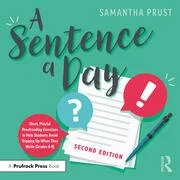
A Sentence a Day: Short, Playful Proofreading Exercises to Help Students Avoid Tripping Up When They Write (Grades 6-9) 2nd Edition
By Samantha Prust
(Routledge/Prufrock Press, 2025 – Learn more)
Reviewed by Kathleen Palmieri
A Sentence a Day is a surprisingly powerful (and easy-to-use) resource for writing instruction that goes beyond the typical grammar and sentence-writing exercises.
Unlike most professional development books focused purely on grammar rules, this text offers an innovative, hands-on approach to helping students develop stronger writing skills with clarity, precision, and creativity.
The book’s structure is unique in that it uses a format of mini-lessons that are ideal for quick 20-minute writing workshops that might be daily or whenever they fit in.
Each page presents a sentence with an incorrect version, a correct version, and helpful notes. Projecting each sentence on the Interactive Flat Board creates an engaging learning environment. This approach allows students to examine what makes a sentence work and why changes are necessary.
The interactive nature of these lessons engages students by inviting them to think critically about grammar, sentence structure, and the role of descriptive details such as adjectives.
Just right for my fifth graders
As a teacher I’ve incorporated these exercises into 20-minute mini-lessons, perfect for my 5th grade classroom. The exercises are structured to grow with the students’ skills, starting with simple sentences and gradually increasing in complexity.
Over time, I’ve noticed a remarkable improvement in how my students approach writing, particularly adding more vivid details, carefully choosing adjectives, and applying grammatical rules with precision.
One of the strengths of A Sentence A Day is that it feels less like a traditional grammar book and more like an engaging, interactive resource. The short, playful, yet educational nature of the sentences makes the lessons enjoyable for students. The e-book version offers 50 exercises with interactive elements, enhancing the learning experience further by allowing students to apply what they’ve learned.
In my classroom, these quick but impactful lessons have not only sparked student interest but have also fostered a more refined sense of sentence crafting.
A tool for upper grades, too
The book isn’t just a resource for middle school teachers – it also works well for higher intermediate grades through high school. Its blend of accessible writing practice and advanced concepts makes it a versatile tool for developing strong, well-rounded writers. After seeing the growth, interaction, and engagement in my class, I’m confident this resource will continue to be a key part of my writing instruction.
In summary, A Sentence A Day is a gem for educators looking for an engaging, concise, and effective way to teach sentence writing and proofreading. It’s much more than a grammar guide – it’s a practical tool for helping students become more confident and precise writers.