Published Articles
*
Published Articles *

Teaching Writing as the Mentor Writer
by Kathleen Palmieri

Do you ever have those days when you think, “How am I going to help my students enjoy writing?” Consider how you approach writing. Are you the “Sage on the Stage”, meaning you lecture and then assign, or do you share commercial writing pieces that help provide a visual or an expectation for the writing? If you answered yes to either question, it may be time to rewind, revise, and reinvigorate your approach and your role. What if you were not only the teacher, but the mentor writer?
As the teacher, set the stage. Deliver direct instruction, build workshop routines, curate resources, and provide actionable feedback so students know where they are and where they’re heading. Most importantly, model how to write starting with a brainstorming lesson. Talk through your thought process and wonderings. Make your ideas visible in your notebook and show your progress. Ask yourself questions to show students how to put their ideas on the notebook page. Get excited as you work through the process to engage your students.
As the Mentor Writer, pull up a chair right next to them. Draft in real time, share actual struggles, model vulnerability, and open yourself up to feedback. It shows students that writing isn't just a school assignment—it’s a real-world practice.
While we spend plenty of professional development honing our teaching strategies, we rarely get the time to nourish our own writing lives.
Ready to bring more of the “Mentor Writer” into your room? Try these simple shifts:
Recognize the writing you already do. Emails, lesson plans, and even report card comments all count. You already have a writing life—talk about it with your students.
Write what you’re teaching. Drafting your own version of a student assignment gives you instant insight into where they might stumble. This is incredibly important!
Teachers and students keep a stress-free writing notebook. Embrace quick writes, messy ideas, and brain dumps. No set schedule; just use it as an inspiration tool.
Use writing notebooks to collect ideas across every subject. "Aha" moments happen everywhere, not just during dedicated writing time. Jotting down dynamic student thinking during a math lesson provides a rich foundation to enrich instructional strategies across all subjects.
Set small goals and extend grace. Start with a “seed” or idea; set a goal for what you want to “publish” or write. Be kind to your writing brain, realizing you will revise, edit, or rewrite, and that is okay. Add experiences, thoughts, and reflections to your writing.
Do you have reluctant writers who will look at the blank notebook page with no confidence? Show students how to brainstorm using Vertical Non-Permanent Surfaces (VNPS), such as a whiteboard. A dry-erase marker can be the “magic wand” for a reluctant writer, even if they only start with a circle to begin a thinking web. Demonstrate with one reluctant writer and show them how to brainstorm together to start with an idea. Start with a “seed idea” in the main circle, then each add a word or thought to a connecting bubble. Using the VNPS and a dry-erase marker may help alleviate reluctance to sharing ideas.
Once the engagement has hooked the reluctant writer, trade your marker with another student who is now part of the “writing team”. However, clearly state with enthusiasm that once they complete an idea web, they will each go to their writing notebooks to expand more on their own.
Like any subject, students will engage and learn in their comfort zone. A blank page in a notebook can be scary to one and a window to creativity to another. A VNPS with dry-erase markers often provides a magic carpet to creativity for many students, offering a “non-permanent” surface to comfort reluctant learners/writers.
The notebook should become a place where students can brain-dump in math. As a mentor, show how you would use your notebook to write down thoughts, wonderings, and ideas in math. Demonstrate how, after working with a team or partner on a math problem using a VNPS, you reflect in your notebook and build on your learning.
Take a moment to reflect: How are you balancing the roles of teacher and Mentor Writer today? Grab a notebook, pick up a pen, and start writing alongside your students.
For more ideas and resources on transforming classroom practice, visit Revolutionizing Learning Paths. A Note on Context: The insights in this piece are drawn from my ongoing journey as an educator—shaped by years of teaching, professional learning, and classroom practice. While this reflects what has worked in my own space, as a book reviewer, I encourage you to explore the rich body of professional books and research available that expands on my practices.
Reigniting the Magic of Reading Physical Books
By Kathleen Palmieri

We can all think back and recall the excitement created by many highly engaging series that had children reading 300+ page books. These memories seem to contradict the current narrative that kids just can’t focus on long texts.
In 2001 a young wizard took the world by storm with a series that became a national phenomenon known as Harry Potter. Author J.K. Rowling crafted characters, settings, suspense, wonder, and magic that captivated readers, both young and old, creating lines of eager readers waiting on book release day for the clock to strike midnight so they could get their hands on the next installment.
Potter’s universal appeal – particularly to 8, 9, and 10-year-olds – was incredible. Students proudly carried around their latest copy and waited for “independent reading time” to dive back into the story. Yet today, getting a large percentage of our students to dive into a physical novel is a chore rather than a pleasure. What happened?
The Rise of Instant Gratification
The shift away from independent reading came in the form of “technology.” Video games, cell phones, apps, and texting offered immediate rewards and engagement. Now, I realize there are reading apps such as Sora and Epic, which provide digital reading and deliver cost savings, but at what cost to physical reading?
The technological shift has hurt the tangible book.
The Unique Value of the Physical Book
I remember as a kid looking forward to library time each week in school. I’d pick out books to share with my parents, sitting by my dad after dinner, reading stories like The Fantastic Mr. Fox by Roald Dahl. My parents were readers, and I recall Sunday afternoons in our den with the fireplace on, snuggled up in a cozy chair, reading a book while my parents read theirs. This was not because I had to, but it was because I looked forward to reading. Are we modeling the love of reading at home?
Libraries offer such an abundance of learning through fiction and non-fiction. Sadly, in some elementary schools, this library time is often not provided to the “older students” (4th and 5th graders!) or worse, sister schools share one librarian, meaning that some libraries may be closed during parts of the school week. Where and when did we lose our appreciation for building a love of reading and looking forward to visiting the library?
In my research on this topic, I came across a Psychology Today post, The Case for Books vs. E-Readers: Why a good old-fashioned book is better for your mental health, which shares these key points:
“Research suggests that comprehension is six to eight times better with physical books than e-readers.”
“Physical books help readers absorb and recall content more effectively.”
“Turning pages as we read creates an ‘index’ in the brain, mapping what we read visually to a particular page.”
I acknowledge apps such as Audible (which I use, but does not replace the joy of holding a book) and the apps I previously mentioned that offer stories and encourage thinking, but let’s consider the differences between digital and physical books.
Though many people find they can read faster on a device, the distractions, like social media scrolling, advertisements, and email notifications, often hinder memory retention. Physical books provide an immersive experience, resulting in readers who absorb and recall the content more effectively.” – Heather Rose Artushin, Psychology Today.
Holding a physical book is a sensory event. It provides a distinct focus and engagement that the physical page demands compared to digital books. I want my students to know the feel of opening a book, turning the pages, and tracking their reading progress as they use a favorite bookmark.
How can we reclaim the magic?
Let’s recreate the frenzy of an awesome book series, highlighting the tangible magic of books! As educators, let’s make it a priority to read books that are geared toward our students’ age range so we can give firsthand reviews that invite and entice their interest. I promise, as soon as you recommend a book, many students will want to read it!
Let’s create dedicated reading spaces in classrooms, and make one of the important jobs “the Class Librarian.” Curate a classroom library where students can always access a good book and instill the importance of taking care of books to be reread and shared with others.
If you are concerned about not using technology to support reading, consider having them record book reviews or book trailers to share with peers and parents in class newsletters. Support book talks.
Want to pump it up to the next level?
Find a series that you can promote to your students to ignite the same excitement as the Harry Potter phenomenon. As a fifth-grade teacher transitioning into a new reading module that focuses on mythology, I will use the Percy Jackson & the Olympians series by Rick Riordan. I will start with book 1, The Lightning Thief, the first in a series of five. It will align perfectly with my students, as it is targeted generally for 4th-8th-grade readers.
This series has a high-concept hook and the “magic” element. The protagonist Percy Jackson (like Harry Potter) is an ordinary kid who suddenly discovers he has special powers. He is a demigod and is plunged into a “secret world,” which makes the series instantly engaging.
To make this even more intriguing, I will read the first chapter of Book One of the series, but also have the stack of all the books in the series next to me. Once I hook my readers, I will tell them that they must read book one to get to book two and so on. Knowing my students, the excitement will have become electric, and the readership in the classroom will skyrocket!
As I developed my plan for this series, I thought about my reluctant readers and found another series recommended for those who may find the Percy Jackson series too much. The The Last Kids on Earth by Max Brallier is a novel that is heavily illustrated (think of it as a novel/graphic novel hybrid, as I’ve heard this series described). There are 10 main books plus spinoffs and guides. This choice helps with readers who are not ready for large blocks of text. It’s a popular set that includes monsters, zombies, and humor.
The legacy of Harry Potter
The phenomenon of the young wizard who took the reading world by storm is not merely popular fiction trivia. It’s definitive proof that when a book is compelling enough, children will not shy away from novels of 300 pages or more. This contradicts the narrative of short attention spans that has beset our digital age.
It is essential that we push back on that narrative and reintroduce the magic of the physical book, with its focus and superior comprehension, and the anticipation it creates to hold the next physical installment in our hands.
Authentic Inquiries Using Gummy Bear Science
By Kathleen Palmieri

How to Grow a Culture of Thinkers in Our Classes
By Kathleen Palmieri

Build Math Confidence in the Intermediate Grades
By Kathleen Palmieri

Help Students Set Goals in All Subject Areas
By Kathleen Palmieri

Math Explorations to Engage Your Students
By Kathleen Palmieri
Science is one subject where students truly come alive when given the opportunity to experiment, question, and discover. The excitement of hands-on labs invites them to think outside the box and connect scientific concepts to their everyday experiences.
When guided by grade-level standards, even simple experiments can become powerful, authentic learning experiences. Here’s an example from my fifth grade classroom.
Building the Foundation: Identifying Materials by Their Properties
The first module I teach each year focuses on the question:
“How can we identify materials based on their properties?”
One of our early investigations begins with the question:
“What happens when materials are mixed with water?”
To explore this, students conduct a simple lab using sugar and water. They carefully measure the weights of both substances before and after mixing, then graph their data. The key discovery? The total weight remains the same, even though the sugar seems to “disappear.” This introduces the concept of dissolving and conservation of mass.
While the sugar-water lab is foundational and hands-on, I often notice that it doesn’t spark much excitement on its own. So, I decided to expand the concept in a way that would truly capture students’ curiosity – and bring a little sweetness to scientific inquiry.
Taking It Further: The Gummy Bear Investigation
Building on a popular internet experiment from over a decade ago, I introduced Gummy Bears as the star of our next lab. The new focus question became:
“What happens to Gummy Bears when they are submerged in different liquids overnight?”
Each lab group received:
A tray with five Gummy Bears (one for control and four for testing)
Four clear plastic cups, each filled one-quarter full with a different liquid: vinegar, water, salt water, and Sprite
A ruler for measurement
Their science notebooks for recording observations
Students began by forming hypotheses about what they thought would happen to each Gummy Bear in the different liquids. They measured their control Gummy Bear, placed the others in their respective cups, and recorded any initial reactions. The real magic happened the next day when they returned to observe and measure their results.
Day Two: Inquiry in Action
The room buzzed with excitement as students examined their transformed Gummy Bears. Some had swollen to surprising sizes, others had shrunk, and a few had begun to break down completely. Students recorded their observations, compared them to their hypotheses, and discussed questions such as:
Why did some liquids cause the Gummy Bear to grow or shrink?
What does this tell us about how materials interact with different substances?
How can we use evidence to explain these changes?
Students used their rulers to compare each treated Gummy Bear with the control, then graphed and analyzed their data to draw conclusions.
Why It Works: Authentic Investigation
This two-day lab does more than engage students – it deepens their understanding of key scientific concepts such as solubility, osmosis, and the properties of materials. By using a familiar and fun object like a Gummy Bear, students stay curious and invested while practicing core scientific skills: measuring, recording, hypothesizing, and analyzing data. And we’ve set the stage for future lessons.
Most importantly, this activity transforms a standard lab into an opportunity for authentic inquiry. It demonstrates that even the simplest materials can lead to big scientific thinking – especially when paired with a question that invites wonder.
As educators, we’ve all seen it – that moment when a student’s eyes light up because something clicks. It’s not because we delivered the perfect lecture or because they filled in the right bubble on a test. It’s because they were thinking. They were engaged, invested, and curious.
What if that moment wasn’t the exception but the norm?
When we build classrooms around how students think and engage – not just what they’re expected to know – we unlock a learning environment where curiosity replaces compliance, and excitement replaces dread. By cultivating deep questioning, valuing student ideas, and intentionally fostering a culture of thinkers, we move from delivering content to developing minds.
The pressure to “cover” curriculum can lead us to default to delivery mode – lecturing, assigning, assessing. But what’s often missing in that cycle is student thought. When we shift our focus from delivering information to guiding thinking, we begin to build environments where learning is owned, not imposed.
This doesn’t mean lowering expectations. On the contrary, it means raising the bar for cognitive engagement. It means designing tasks and discussions that challenge students to make meaning, explore connections, and reflect on their understanding – not just repeat what they’ve heard.
Asking the right questions
Great teaching isn’t about having the right answers – it’s about asking the right questions. Our questions shape the intellectual climate of our classrooms. Closed, factual questions may check for understanding, but they rarely generate it. Instead, consider questions that:
Invite reasoning: “Why do you think that?”
Encourage curiosity: “What do you notice? What do you wonder?”
Promote connections: “How does this relate to what we’ve learned?”
Challenge assumptions: “What if we thought about it this way?”
Even more powerful is teaching students how to ask these questions themselves. When students are equipped to turn their thinking into deeper questions, they move from passive recipients of information to active constructors of knowledge. This metacognitive move – thinking about their own thinking – is where true intellectual growth happens.
The elements of classroom culture
Creating a classroom culture where thinking thrives doesn’t happen by accident – it requires deliberate design. This culture is built on norms, expectations, and daily practices that prioritize thinking over correctness, process over product.
Here’s what that can look like:
Thinking routines that scaffold student responses and deepen engagement.
Wait time and silence, signaling it’s okay to pause and process.
Celebrating errors as evidence of thinking, not failure.
Collaborative discourse where students learn with and from one another.
Visible thinking through journals, diagrams, and shared reflections.
When students see that their ideas have weight – and that their peers’ ideas do too – they begin to approach learning with ownership and purpose. They don’t just want to get the answer; they want to understand.
We all want our students to thrive across subjects – but that won’t happen through rote learning. A thinking-centered classroom prepares students to engage meaningfully with every discipline:
In math, students move beyond procedures to problem-solving, reasoning, and pattern recognition.
In science, they shift from memorizing facts to designing experiments and interpreting evidence.
In literacy and social studies, they learn to analyze, synthesize, and evaluate multiple perspectives.
In the arts, they explore creative processes, reflect on intent, and communicate meaning.
Thinking isn’t a skill taught in isolation – it’s embedded in every discipline. When we teach students how to think like mathematicians, scientists, historians, and artists, we help them see learning as an interconnected, lifelong process. Our ultimate goal isn’t just to produce students who can pass exams. It’s to nurture individuals who are curious, reflective, and capable of tackling complex problems – both in and out of school.
As fellow educators, we know the constraints are real: time, testing, and pacing guides. But within those boundaries, there is room – and urgency – for us to design classrooms that center student thinking. The payoff is immense: engaged learners, deeper understanding, and a classroom where every student feels seen, challenged, and empowered.
Let’s move from classrooms of compliance to classrooms of curiosity. Let’s make thinking the standard, not the exception.
Building math confidence among students in the upper elementary grades is a necessary goal for educators and parents alike. At this stage in their education, students begin to encounter more complex mathematical concepts, and many may start to doubt their abilities to “do” math.
However, with the right strategies and mindset, it’s possible to help intermediate students develop the confidence they need to tackle math with enthusiasm. Below are some key strategies that I’ve developed in my own fifth grade classroom that are working for me.
1. Create a Positive and Supportive Learning Environment
A positive classroom atmosphere is a cornerstone to building confidence in math. Students should feel safe to make mistakes and learn from them. Encouraging a growth mindset – where students believe that abilities can improve with effort – can be highly effective. Praise effort over innate ability, and emphasize that mistakes are an essential part of learning. Creating a culture of collaboration and discussion allows students to learn from each other.
2. Break Down Complex Concepts
Many intermediate-grade students may feel overwhelmed by more advanced mathematical topics. Breaking down these concepts into smaller, more manageable steps can help. Start with concrete examples and use visual aids, such as number lines, graphs, and manipulatives, to help students understand abstract concepts. When students can grasp the foundational ideas step by step, they feel more confident in tackling increasingly complex problems.
3. Link Real-World Applications
Linking math to real-world relatable situations can help students see its value and relevance. For example, show them how math is used in everyday activities like shopping, cooking, or planning a trip. When students understand how math applies to their daily lives, they are more likely to view it as something useful rather than a challenging subject.
RESEARCH NOTE: In past articles I have shared my research and fascination with the work of Dr. Jo Boaler, author, professor and co-creator of Youcubed.org. In several articles here at MiddleWeb I’ve shared what I’ve learned from Dr. Boaler and how I’ve incorporated more math activities, data science, and number talks into my in math classroom. Those articles include Teach Math by Diving Deep Into Real Data; Number Sense Builds a Strong Math Foundation; and Math Explorations to Engage Your Students.
4. Provide Opportunities for Success
Small successes can lead to big boosts in confidence. Give students opportunities to solve problems they can handle before gradually introducing more difficult challenges. Success in solving simpler problems can empower students to tackle more complex ones with greater confidence. Celebrate these successes, even if they are small, to reinforce a sense of accomplishment. This helps to encourage and engage students in future problem-solving.
5. Encourage Problem-Solving Strategies
Teaching students problem-solving strategies can empower them to approach math with confidence. Strategies such as drawing pictures, looking for patterns, or breaking problems into smaller parts can help students feel more equipped to solve challenging problems. When students have a toolkit of strategies to rely on, they are less likely to feel defeated by difficult problems.
6. Use Technology and Interactive Tools
Technology can make learning math more engaging and interactive. There are a variety of math apps, games, and websites that offer interactive lessons and practice problems. These tools allow students to work at their own pace and receive immediate feedback, which can build confidence over time. Gamifying math through these platforms can make learning feel more like a fun challenge rather than a stressful task.
7. Encourage a Growth Mindset
A key aspect of building math confidence is helping students develop a growth mindset. This is a big part of my classroom culture. Encourage students to view challenges as opportunities for growth, rather than obstacles to success. Teach them that skills are developed through effort and perseverance, and emphasize the importance of persistence when they encounter difficulties.
8. Provide Encouraging Feedback
Providing constructive and encouraging feedback is essential in helping students build confidence. Rather than focusing solely on what was done wrong, offer praise for what was done correctly and suggest ways to improve. For example, if a student struggles with a particular problem, help them understand their error and guide them through the correct approach. Positive reinforcement is a powerful tool for encouraging a positive attitude toward math.
9. Foster a Sense of Autonomy
Allowing students some degree of control over their learning can help them feel more confident in their abilities. Let them choose problems to work on, or offer them choices in how they approach assignments. When students have some autonomy, they feel more invested in their learning and more confident in their ability to succeed.
10. Promote a Collaborative Learning Environment
Encourage students to work together and share their strategies and solutions. Collaborative work (well-facilitated by the teacher) can help students learn from each other and gain new perspectives. When students feel part of a team, they often feel more confident and motivated to take risks in solving problems.
Building Math Confidence Takes Time
Building math confidence in our Intermediate grade students is a gradual process that requires patience, encouragement, and the use of effective teaching strategies. This is by and large a group that’s still curious and open to learning. By creating a supportive learning environment, breaking down complex concepts, and fostering a growth mindset, educators can help these early middle level kids overcome their math anxiety and develop the confidence they need to succeed in mathematics.
And when students feel confident in their mathematical abilities, they are more likely to embrace other academic challenges and develop a lifelong love of learning.
Goal setting is a powerful tool for students, offering clarity, motivation, and a roadmap to academic achievement. Whatever the grade level, setting clear, attainable goals helps students stay focused, develop self-discipline, and build a growth mindset for academic success and lifelong skills beyond the classroom.
Let’s look at how to guide students in setting effective goals holistically, across all subject areas, and break down the importance of goal setting in different subject areas.
In every case, we want to remember the importance of mindfulness in ensuring that the process is purposeful and sustainable.
The Power of Goal Setting in Education
Setting goals provides students with a sense of purpose and direction and a more positive attitude toward learning. It enables them to track progress, identify challenges, and experience a sense of achievement when they meet milestones.
It’s crucial for goals to be specific, measurable, and achievable. When students see real results from their efforts, it boosts their confidence in their abilities. They find their power source.
Goal Setting in the Core Subject Areas
1. Math: Building Problem-Solving Confidence
Math can be a challenging subject for many students. Setting specific, incremental goals in math helps students focus on mastering individual concepts before moving on to more complex ones. For example, a student might set a goal of completing 10 math problems every week to build fluency in addition or subtraction, and then progress to tackling algebraic equations or word problems.
Why these goals are important: In math students often face frustration due to the progressive nature of the subject. Setting smaller, attainable goals allows students to build confidence as they master each concept. It also helps them stay motivated as they visualize progress through consistent practice.
Why mindfulness is important: Practicing mindfulness in math can help students stay calm and focused when faced with challenging problems. By being present in the moment, they can reduce anxiety and avoid feeling overwhelmed. Mindfulness techniques, such as deep breathing and focusing on the process rather than the outcome, can also improve problem-solving skills.
2. Science: Developing Curiosity and Critical Thinking
In science, goal setting helps students engage in the inquiry process, think critically, and approach experiments and investigations with curiosity. A student might set goals to improve on writing a claim or to develop a deeper understanding of a scientific concept like the water cycle or ecosystems.
Why these goals are important: Science encourages students to explore and question the world around them. By setting goals to deepen their knowledge, students can strengthen their critical thinking skills, essential for conducting experiments and analyzing results.
Why mindfulness is important: Mindfulness practices in science can encourage students to observe their surroundings more carefully, ask questions, and be present and alert during experiments. It promotes curiosity and patience, allowing students to appreciate making discoveries without rushing to conclusions.
3. English: Enhancing Writing and Reading Skills
In English, goal setting is particularly helpful in improving writing, reading comprehension, and language skills. A student might set goals to read a certain number of books in a month or to write a persuasive essay with stronger arguments and clearer structure.
Why these goals are important: English is a foundational subject that develops communication skills, critical thinking, media awareness, and creativity. Setting clear goals in English helps students work on specific aspects of their reading and writing, such as growing vocabulary, improving grammar, and analyzing texts.
Why mindfulness is important: Mindfulness in English helps students develop deeper concentration when reading and writing. It allows them to engage fully with the material, making it easier to deconstruct texts and express their ideas clearly. Mindfulness techniques, like focused breathing, can also calm students who experience anxiety when faced with writing assignments or reading comprehension tests.
4. Social Studies: Understanding Context and Perspective
Setting goals in social studies helps students understand historical events, geography, and cultural dynamics. Goals in this area include improving note-taking skills or understanding the impacts of historical events, such as the American Revolution or the global slave trade.
Why these goals are important: Social studies provides students with an understanding of the world’s history, government systems, and global issues. By setting goals in this subject, students develop a deeper understanding of context and perspective essential for making informed decisions in the future.
Why mindfulness is important: Mindfulness practices in social studies can help students approach historical events with an open mind and develop empathy for different perspectives. Being mindful of one’s biases and focusing on the historical context can foster a more balanced and thoughtful approach to learning.
More about Mindfulness and Goal Setting
Mindfulness is a practice that encourages students to be fully present and aware of their thoughts, feelings, and surroundings. Incorporating mindfulness into goal setting can help students create realistic, focused, and achievable goals. Here’s how mindfulness supports the process:
►Self-Awareness: Mindfulness helps students become more aware of their strengths and challenges, which is essential when setting realistic goals.
►Reduced Stress: By practicing mindfulness techniques, students can reduce the stress and anxiety that sometimes accompany goal setting, particularly in high-pressure subjects or standardized testing.
►Improved Focus: Mindfulness boosts concentration and focus, making it easier for students to stay on track with their goals.
►Resilience: Mindfulness encourages a growth mindset, helping students view setbacks as opportunities for learning rather than failures.
A Balanced Approach to Success
Setting goals across all subject areas is an important practice that helps students excel academically and nurtures essential life skills. By encouraging students to set specific, measurable goals in subjects like math, science, English, and social studies, educators help to foster a sense of achievement and motivation.
Incorporating mindfulness into this process enhances students’ ability to stay present, focused, and calm, further strengthening their commitment to their goals by drawing on their own power. In this way, students are setting themselves up for academic success and learning valuable life skills.
If you’d like to know about the benefits of teacher mindfulness, please read my MiddleWeb article, Teacher Mindfulness Leads to Wellness.
As the school year winds down, it is easy for students to lose their momentum for subjects and think about having fun in the sun. One way to help ease students into summer mode, but still sneak in some math review, is to find engaging activities.
In past articles I have shared my research and fascination with the work of Dr. Jo Boaler, author, professor and co-creator of Youcubed.org. In my articles Teach Math by Diving Deep Into Real Data and Number Sense Builds a Strong Math Foundation I’ve shared what I’ve learned from Dr. Boaler and how I’ve incorporated math activities, data science, and number talks into my math classroom.
For all of us not quite out of school yet, here’s some more of what I’ve found!
The bunny hop
The end of the school year is a great time to use activities that allow students to discuss, guess, share strategies, and talk through problem-solving in math. To engage students in a fun number sense task, I’ve had my students use the Youcubed activity Leo the Rabbit where students are given the task to find how many ways Leo can hop up 10 steps. (Leo can only hop up 1 or 2 steps each time he hops.)
This activity incorporates exploration and number sense and is highly engaging as the students find themselves in a bit of productive struggle. The math discussions are incredible and students demonstrate some excellent number sense skills in their problem solving. If you’re already out of school, save this engaging activity for fall!
A cuboid expedition
Most recently, I had my class dive into the 30 Cubes activity. This is one of my favorite end-of-the-year things to teach as it is all about math exploration. As stated on youcubed.org,
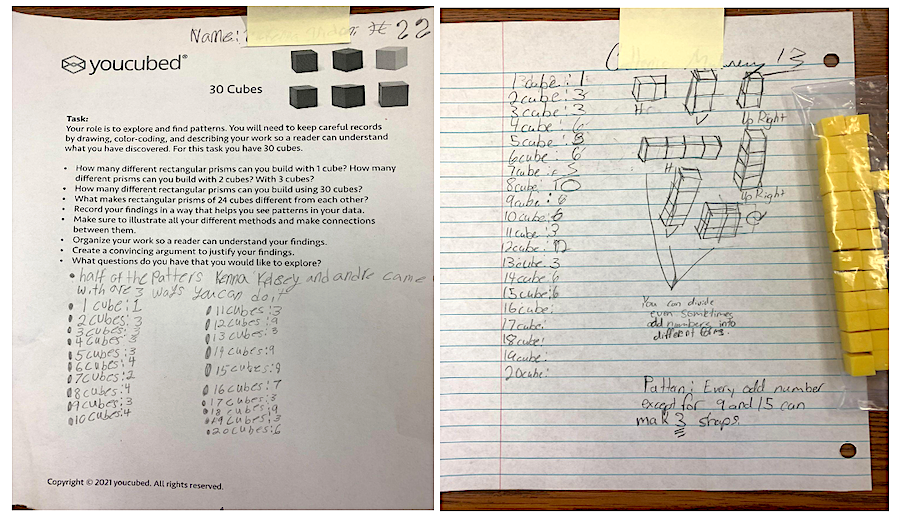
“This task is intended to support students building their own identity as a mathematics explorer. They will generate their own data and look for patterns within a sequence. They should work to determine ways to organize their findings so they can make convincing arguments and conjectures. Students are asked to think in cubes by building, drawing, and quantifying their results. How many different rectangular prisms, which Jo calls cuboids, can you make using 1 cube, 2 cubes, 3 cubes and onwards to 30 cubes?”
I have used this activity several times in the past, and each time I am amazed at the conversations and the diversified ways students worked to build the rectangular prisms with a certain amount of cubes. I always started with a “Notice and Wonder” as suggested by Youcubed.
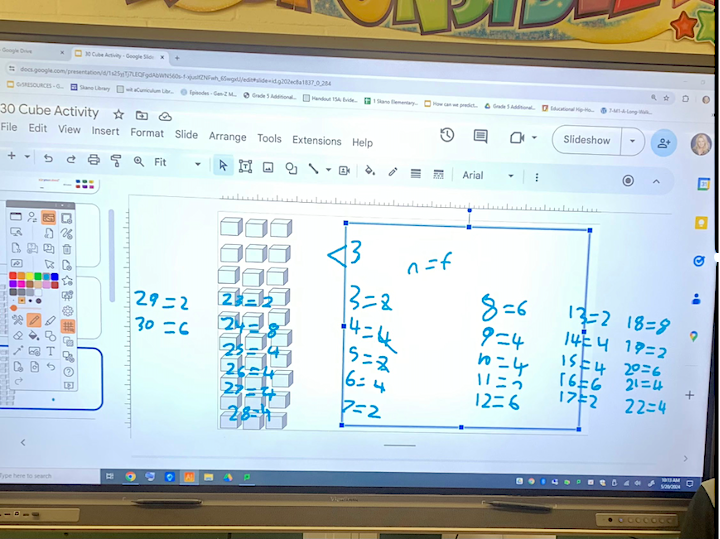
Some students immediately want to manipulate the cubes while others begin to sketch out their thoughts. A few students line up cubes in horizontal and vertical lines, adding height with others. They decided to use the volume formula to help them create different prisms. I decided to offer a digital Google Slide deck as an alternative way for students to move the cubes around.
Once ample time was provided, my students were excited to present their findings in terms of patterns, number sense (discussing prime and composite numbers!), how they manipulated the cubes, and how some used the volume formula in their exploration.
One group (shown on the slide deck picture below) explained a pattern they found in their data – all the prime odd numbers created two, except for numbers 9 and 15.
As groups presented, students asked questions and shared thoughts. It was a wonderful math discovery session that engaged all students. The best part was that no student was hesitant to share as they weren’t afraid of being wrong. It was fascinating to see the diagrams, building, computation, and overall thought process that went into this activity.
A summer read for math teachers
I recently wrote a book review of Jo Boaler’s latest book, Math-ish: Finding Creativity, Diversity, and Meaning in Mathematics. This book is written in a conversational tone and easy to enjoy. I read it in two days and walked away with more ideas to boost my math practice. My other articles, previously linked above, also reference Dr. Boaler’s work, with links to guide the reader to her papers and books.
Learning by doing and discussing
Providing math activities is a great way to instill a love of math and exploration in students. I truly believe the student learns more by doing and discussing than any rote operational assignment. Youcubed.org and Dr. Jo Boaler’s work offers so much enhancement to my math classroom, and I highly recommend math educators check out these resources.
I hope you’ll read and try some of the activities I’ve mentioned. Please let me know what you think, and whether you’ve used any of the activities from youcubed, either in the comments section below or by writing me at kathiepalmieri@gmail.com. I look forward to your thoughts and ideas.